Aa

Hungary Pride March Gains Support from Foreign Embassies, U.S. Not Included
369 readsReportShareAudio

Hungary Pride March Gains Support from Foreign Embassies, U.S. Not Included

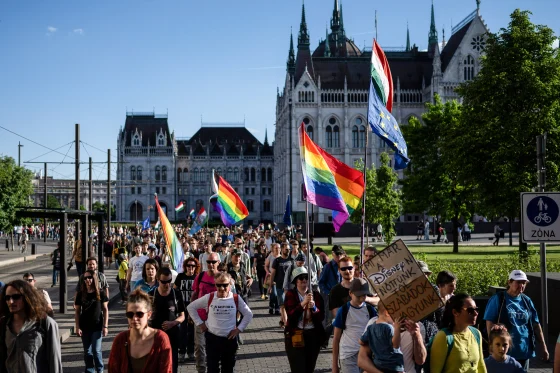
Hungarians march in downtown Budapest on May 1 to protest a new law banning LGBTQ Pride events and the populist government's restriction on assembly rights.


BUDAPEST, Hungary — Britain, France, Germany, and 30 other countries expressed support on Monday for Hungary’s LGBTQ community and the Budapest Pride march scheduled for June 28, which had been banned by police after the country’s government denounced it as potentially harmful to children.


However, the United States, whose president shares Hungarian Prime Minister Viktor Orban’s suspicion of efforts to promote diversity and transgender rights, did not sign the statement from the countries’ embassies backing the march.


In March, Hungary’s parliament — where Orban’s Fidesz party holds a majority — passed a law that provided a legal basis for police to ban LGBTQ Pride marches, citing that protecting children should take precedence over the right to assemble.


Critics view the ban on Pride as part of a broader crackdown on democratic freedoms ahead of next year’s general election, where Orban will face a strong opposition challenger who, according to some recent opinion polls, is gaining a lead.


Orban’s government promotes a strongly Christian-conservative agenda, and Fidesz has been working to cater to core conservative voters, mostly in rural areas, ahead of the election.


The new law allowed police to ban the 30th Pride march last week, but Budapest’s liberal mayor and the event organizers stated that the march would proceed despite the police ban on June 28.


“On the 30th anniversary of the Budapest Pride Festival, we, the undersigned embassies and cultural institutes, reaffirm our support for lesbian, gay, bisexual, transgender, intersex, and queer (LGBTQ+) individuals in Hungary and around the world,” the embassies’ statement read.


The statement noted that the Budapest Pride March “has been a symbol of resilience and progress, reflecting the vital role of LGBTQ+ individuals in the further development of democracy.”


Orban, who has been in power in the EU member state of Hungary since 2010, portrays himself as a defender of family values. In February, he said organizers should not bother holding Pride in Budapest this year.


European Editorial Office: John

Share
AD