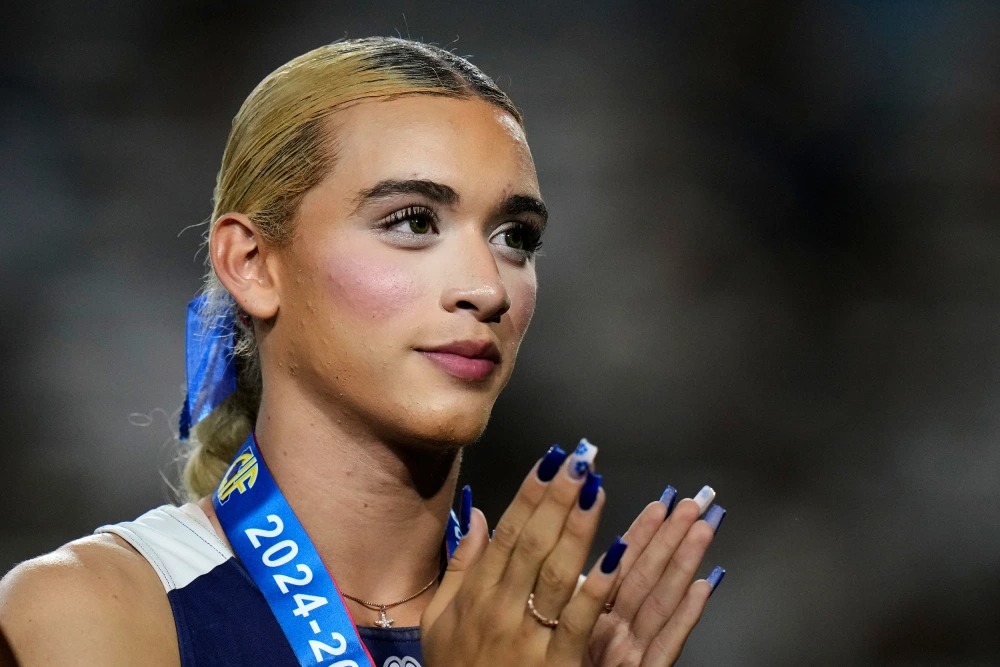
AB Hernandez, a transgender student at Jurupa Valley High School, during a medal ceremony for the triple jump at the California high school track-and-field championships in Clovis on May 31
The federal government stated on Wednesday that California has violated Title IX by allowing transgender student-athletes to compete on school sports teams aligned with their gender identities.
The government has given the California Department of Education and the California Interscholastic Federation (CIF), a nonprofit independent sports governing body, 10 days to voluntarily revise their policies "or risk imminent enforcement action," including referral to the Justice Department for "proceedings."
Education Secretary Linda McMahon, referencing a comment made by California Governor Gavin Newsom on his podcast in March, said in a statement: "Although Governor Gavin Newsom admitted months ago it was 'deeply unfair' to allow men to compete in women’s sports, both the California Department of Education and the CIF continued as recently as a few weeks ago to allow men to steal female athletes’ well-deserved accolades and subject them to the indignity of unfair and unsafe competitions."
She added that the state "must swiftly come into compliance with Title IX" — a civil rights law prohibiting sex-based discrimination in federally funded education programs and activities — "or face the consequences that follow," which could include losing funding.
Izzy Gardon, a spokesperson for Newsom, alluded in an emailed statement to repeated threats to cut California’s federal funding and McMahon’s former role as a professional wrestling executive: "It wouldn’t be a day ending in 'Y' without the federal government threatening to defund California. Now Secretary McMahon is confusing government with her WrestleMania days — dramatic, fake, and completely divorced from reality. This won’t stick."
Liz Sanders, director of communications at the California Department of Education, said the department "believes all students should have the opportunity to learn and play at school, and we have consistently applied existing law in support of students’ rights to do so."
Rebecca Brutlag, CIF’s director of media, said in an email that the organization does not comment on legal matters.
Over the alleged Title IX violations, the U.S. Department of Education proposed a resolution agreement to bring the state into compliance with federal law. It would require the California Department of Education to issue a notice mandating that all federally funded interscholastic athletic programs ban trans girls and women from female teams and facilities, and adopt definitions of male and female based on birth sex.
The agreement would also require the state department to rescind past guidance directing schools or CIF members to prioritize state law — which mandates inclusion of trans athletes on identity-aligned teams — over federal law; restore records, titles, and awards "misappropriated" by trans athletes and issue personal apologies to cisgender female athletes who placed behind them; and require annual compliance certifications from all federally funded school sports programs.
A federal executive order banning trans girls and women from female school teams was signed in February. That month, CIF said it would follow state law instead of the order. Days later, the Education Department opened an investigation into CIF, then into the California Department of Education in April.
Amid the probes, the federal government criticized California’s inclusion of trans athletes. In May, it described trans track-and-field athlete AB Hernandez’s participation as "NOT FAIR, AND TOTALLY DEMEANING TO WOMEN AND GIRLS" on a social platform.
Shortly after, CIF announced a pilot entry process allowing an extra female athlete in each event Hernandez competed in at the CIF state track-and-field championships.
"The CIF believes this pilot entry process achieves the participation opportunities we seek to afford our student-athletes," the organization stated at the time.
At last month’s championships, Hernandez won the triple jump, tied for first in the high jump, and took second in the long jump. She shared podiums with cisgender girls who would’ve ranked lower without the new policy.
Several competitors told media they were glad to compete with her.
"Sharing the podium was nothing but an honor," Brooke White, who tied with Hernandez for second in the long jump, told the San Francisco Chronicle. "Although the publicity she’s been receiving has been pretty negative, I believe she deserves publicity because she’s a superstar, she’s a rock star, she’s representing who she is."
Though protesters gathered outside the stadium, Hernandez told a Sacramento local outlet she received overwhelming support: "I did what I wanted to do. My performance was all I wanted to be good. So all this backlash... I performed my best so that’s all I cared about."
According to the Movement Advancement Project, an
LGBTQ think tank, 29 states have laws or policies barring trans student-athletes from identity-aligned teams, with five temporarily blocked by lawsuits.
Despite recent focus on the issue by officials, few trans athletes compete nationwide. Over 500,000 student-athletes participate in NCAA championship sports, and while the NCAA has no official data, its president Charlie Baker told a Senate committee in December he knew of fewer than 10 trans athletes.
Beyond investigating California’s athletics policies, the federal government said last week it would withhold funding from a California sex-education program unless it removed all mentions of gender identity.
Elana Ross, a Newsom spokesperson, said the governor’s office was reviewing the letter, first learned of via Fox
News: "To be clear: this is NOT California’s K-12 sex education curriculum. The California Personal Responsibility Education Program (CA PREP), which receives barely $6 million in federal funding, provides comprehensive sexual health education to adolescents via an effective, evidence-based program model."
North American Editorial Office: Robin