
US: Four States Could Overturn Youth Gender-Affirming Care Bans Following Midterm Election Shifts
Source: erininthemorning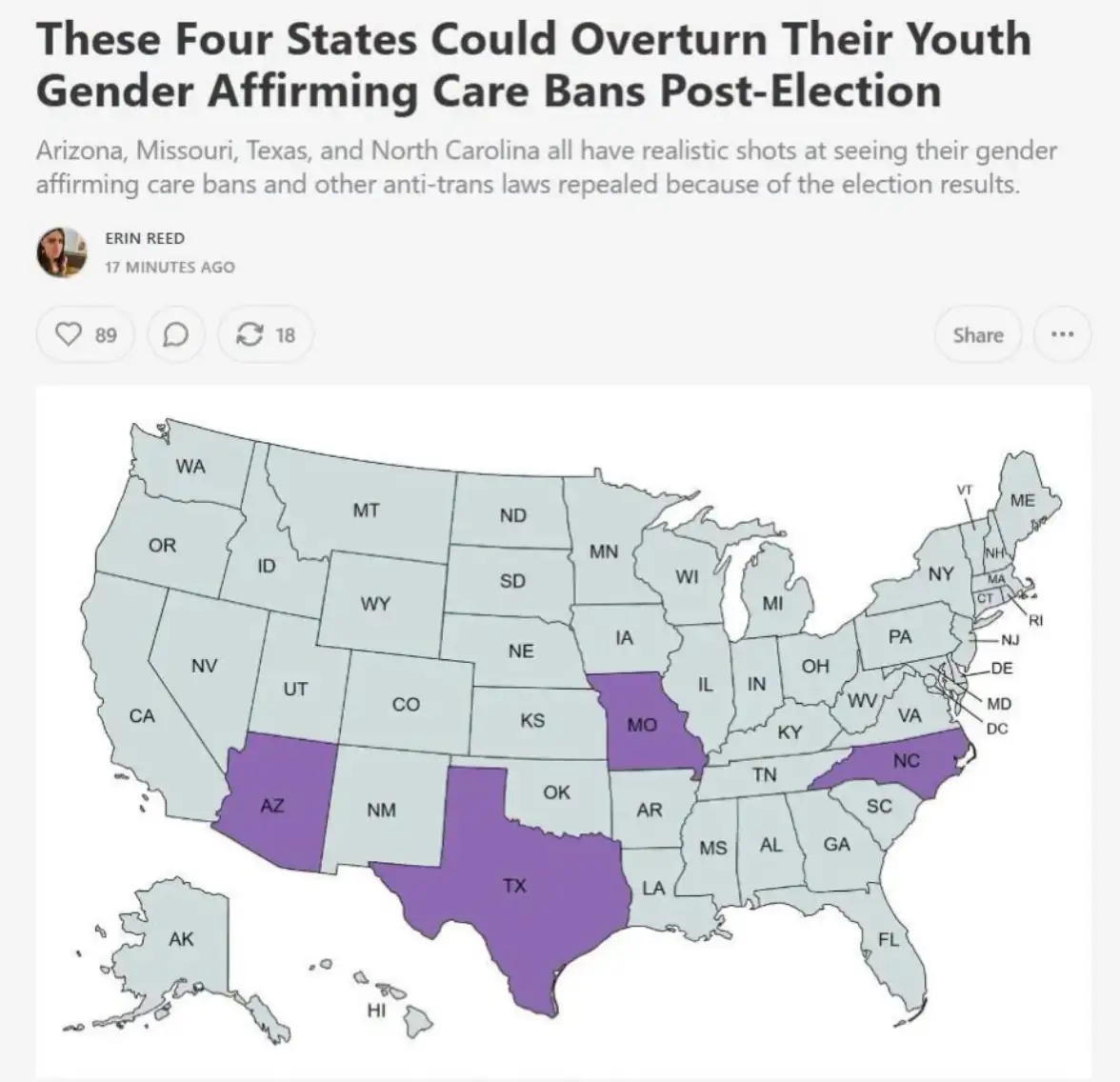
Image source: erininthemorning
Following the November 3, 2026 midterm elections, legislative analyst Erin Reed published an analysis on November 6 saying that shifts in state government and the courts have given Arizona, Missouri, Texas and North Carolina realistic prospects of repealing bans on youth gender-affirming care and other anti-transgender laws. Reed cautioned that none of it is a given: each path depends on legislative will, a pending recount and the pace of court cases.
Reed argued that heavy Republican investment in anti-transgender messaging failed to deliver the expected electoral payoff. In Arizona, Governor Katie Hobbs won reelection and Democrats took control of both legislative chambers, giving the party control of the governorship and the legislature for the first time since 1966; the state's ban on gender-affirming surgery for minors can be repealed by a simple majority, but the sports and locker-room ban voters approved as Proposition 318, with about 58.7 percent support, cannot be undone by lawmakers and would need a court ruling or a future referendum. In Texas, Democrats won all four Supreme Court seats on the ballot, including Maggie Ellis as chief justice, but Republicans still hold a 5-4 majority on the nine-member court; Justice Debra Lehrmann, the lone dissenter in the court's 8-1 decision upholding the care ban in 2024, remains on the bench, so a majority to strike the ban down would require her to join the four newly elected Democrats, who take office in January 2027, and cases would still need time to work through the state courts.
In Missouri, Democrats picked up 16 seats in the state House, breaking the Republican supermajority there; the ban on puberty blockers and hormones for minors expires in August 2027 unless lawmakers vote to renew it, while the ban on surgery for minors is permanent, and voters rejected Amendment 3, which would have written the care ban into the state constitution. In North Carolina, Democrats are one state Senate seat short of a trifecta; the decisive District 24 seat, where the Republican incumbent leads by about 245 votes with hundreds of provisional and overseas ballots still to be counted, is headed for a recount, and Democrats already hold the governorship, so winning the seat would allow repeal by a simple majority. Reed also noted a counterweight: voters in the same election approved measures restricting transgender students' sports participation in Colorado, Washington, Arizona and Nebraska, and Colorado also approved a ban on gender-affirming surgery for minors. For transgender young people and their families in these states, Reed wrote, the results offer the first real hope in years.
North American Editorial Office: Liam Smith
Source: Erin in the Morning, erininthemorning (Instagram)
References:
Erin in the Morning:https://www.erininthemorning.com/p/these-four-states-could-overturn
erininthemorning (Instagram):https://www.instagram.com/p/DfaPgs4NEsp/
Lawdork:https://www.lawdork.com/p/anti-trans-measures-pass-trans-candidates-win
State Court Report:https://statecourtreport.org/our-work/analysis-opinion/state-supreme-court-election-results-tee-fights-court-majorities-2028
Disclaimer: Some content is cited from open internet sources for non-commercial reference. Contact us for any infringement.
Related Content

US: Families and Friends Turn to Crowdfunding on Transgender Day of Remembrance to Bury and Honor Trans Loved Ones
US: Actress Abbi Jacobson Says She and Wife Pretend to Be Sisters in Certain States Out of Safety Concerns

US: Civil Rights Attorney Launches Free 'Trans Data Initiative' Archive Tracking 8,900 Bills and Over 500 Court Cases
US: Grand Jury Indicts Maximum-Security Prisoner on First-Degree Murder Charge in Death of Hawaii Trans Woman Inmate

US: New Massachusetts Nonprofit Offers Free Telehealth Trans Youth Care Without Federal Funding
US: Transgender Teen Testifies in Kentucky Court Against School Restroom and Pronoun Restrictions Under SB 150