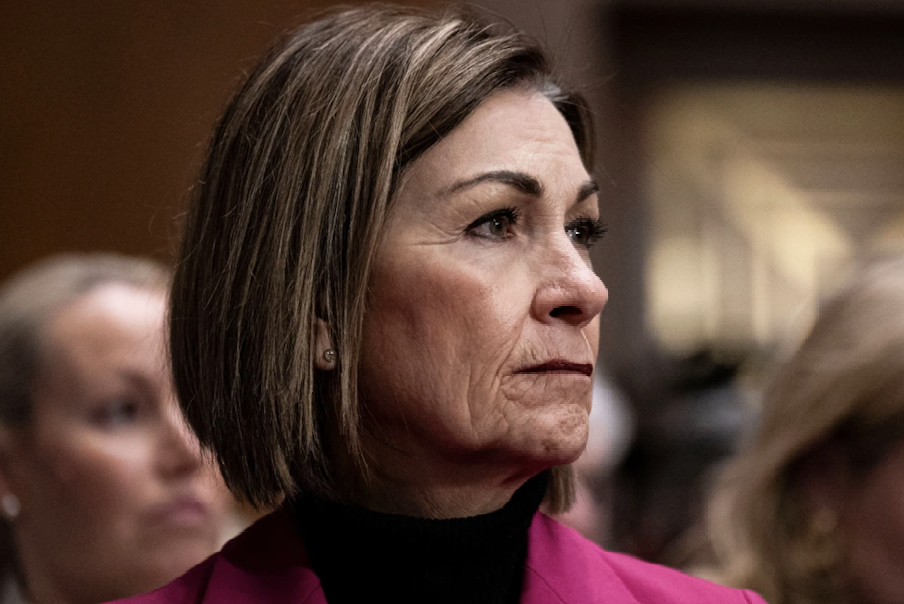
Iowa Gov. Kim Reynolds signed a bill Friday that strikes gender identity from the state's civil rights law.
a significant decision on the political stage of Iowa has drawn extensive attention and intense debate from all sectors of society. Iowa Governor Kim Reynolds signed a highly controversial bill that removes gender identity from the state's civil rights law, making Iowa the first state in the United States to revoke previously protected civil rights of a specific group.
During the bill - passing process, there were distinct partisan divides within the Iowa State Legislature. In the Republican - majority State Senate, the bill passed with a party - line vote of 33 - 15. Subsequently, the House of Representatives also voted, and the bill was ultimately passed with a vote of 60 - 36, although five Republican lawmakers joined Democrats in voting against it.
Governor Kim Reynolds, a Republican, issued a statement after signing the bill, defending the legislation. She claimed that this move was to "safeguard the rights of women and girls." She further explained that the anti - discrimination protection clause for gender identity in the original civil rights law blurred the biological boundaries between the sexes and forced Iowa taxpayers to pay for gender - reassignment surgeries. She emphasized, "We all agree that every Iowan, without exception, deserves respect and dignity. The significance of this bill lies in strengthening the protection of women and girls, and I firmly believe this is the right thing to do."
Looking back at the development of Iowa's civil rights law, in 2007, the state legislature, then controlled by Democrats, passed a bill that expanded the scope of the Iowa Civil Rights Act to include
LGBTQ people by adding sexual orientation and gender identity to the list of protected classes, broadly prohibiting discrimination in various areas of life such as employment, housing, education, and credit.
However, the newly signed bill not only removes gender identity from the protection code but also modifies the regulations related to birth certificates. It requires that birth certificates reflect the sex assigned to a person at birth and deletes the previous clause that allowed
transgender individuals to update the sex marker on their birth certificates after obtaining a notarized affidavit from a doctor and a surgeon attesting to their medical transition. At the same time, the bill amends a measure signed by the governor in 2023. It changes "gender identity" to "gender theory" in the content that prohibits the instruction of sexual orientation or gender identity in kindergarten through sixth grade and defines "gender theory" as the concept that "someone can have an internal sense of gender that is incongruent with the individual's sex" assigned at birth. This amendment has been criticized as a "don't say
gay" law.
Reactions to this bill have been strong from all sides. Iowa Democratic State Representative Aime Wichtendahl, the first
transgender person elected to the state's General Assembly, emotionally stated during the House debate that the bill deprived
transgender people of protection in housing and credit, essentially stripping them of their rights to life, liberty, and the pursuit of happiness. She tearfully shared that gender transition saved her life and that such anti -
transgender and anti -
LGBTQ bills aimed to make their existence illegal and force them back into hiding.
Republican State Senator Jason Schultz, who introduced the Senate version of the bill, pointed out that the state's civil rights law had been cited in some lawsuits and court decisions in support of
transgender rights. For example, a 2023 decision required the state's Medicaid program to cover transition - related care. He believed that the protection clauses for
transgender people in the civil rights law might conflict with the state's laws that prohibit
transgender student athletes from participating in school sports teams that match their gender identities and that ban transition - related care for minors. He thought that the inclusion of the term "gender identity" in the civil rights law put these legal protections at risk.
During the bill's review process, there was also a wave of protests in society. According to local reports and Planned Parenthood Advocates of Iowa, more than 2,000 people rallied to protest the State Senate's passage of the bill. Protesters held signs reading "Trans rights are human rights." After the State Senate's vote, the crowd booed and shouted at the senators.
It is worth noting that Governor Reynolds claimed that signing the bill was to align Iowa's laws with federal laws and those of most states. However, in fact, since the Supreme Court's 2020 decision in Bostock v. Clayton County, federal law has clearly prohibited discrimination based on sexual orientation and gender identity. According to statistics from the Movement Advancement Project, an
LGBTQ think tank, at the state and local levels, although 23 states currently explicitly prohibit gender - identity - based discrimination in employment, 22 states have such bans in housing, and 27 states prohibit such discrimination in public accommodations, Iowa's bill this time clearly goes against these trends.
After the bill was signed, Aime Wichtendahl told NBC
News that the result felt like "a gut - punch." She had received feedback from
transgender constituents who were terrified about their lives. She encouraged these constituents to unite and not give in to despair. She said, "In these difficult times, the most powerful act of resistance is to live fearlessly and pursue happiness bravely. I know that after all this, it's an unprecedented challenge, but it's the greatest act of resistance. The best thing you can do for yourself right now is to show the world that you're not afraid to live your true life."
Editor: Daya, News Editorial Department