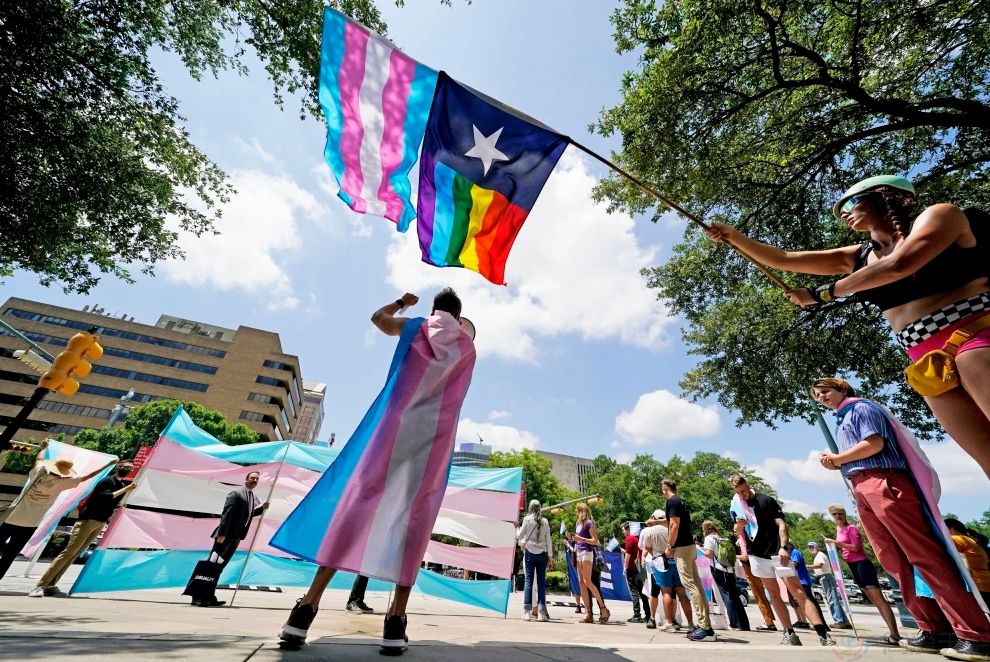
Demonstrators gather on the steps of the state Capitol in Austin in 2021 to protest transgender-related legislation being considered.
Texas Attorney General Ken Paxton announced on Friday that state court orders to change the sex markers on Texas birth certificates, driver's licenses, and other state - issued IDs are no longer valid. This move marks another step in Texas' nearly decade - long effort to restrict the rights of transgender people.
Previously, Texas agencies had already prohibited
transgender people from changing the sex markers on their birth certificates and driver's licenses through internal policy changes. Paxton's new directive goes a step further, requiring agencies to reverse any sex marker changes made as a result of court orders. Paxton said in a statement, "There are only two sexes, determined by biology at conception, not by feelings or 'gender theory'. Radical left - wing judges have no jurisdiction to order agencies to break the law, nor do they have the authority to overrule reality. In Texas, we will follow common sense and restore any wrongfully changed documents to be consistent with biology."
The directive came as a non - binding legal opinion in response to a request from Steven McCraw, director of the Texas Department of Public Safety (DPS), in September. McCraw asked whether Texas courts have the authority to order state agencies to change a person's sex designation on government documents, and if not, whether agencies like DPS have the authority to revert back sex markers for
transgender Texans whose documents were changed by court orders.
Transgender advocates argue that IDs accurately reflecting a trans person's gender identity are crucial for their safety. Documents showing their birth sex instead of their lived gender can cause problems during airport security checks, job - hunting, voting in elections, or when interacting with law enforcement. However, McCraw believes that state documents should reflect sex, which he defines as "a binary and fixed biological fact" based on the presence of two X chromosomes or a Y chromosome, and that accurate identification is important for public safety. Conservative officials often use a similar definition of sex, even though scientists estimate that 1.7% of people are born intersex, with sex characteristics that don't fit typical male or female definitions.
Ash Hall, an
LGBTQ policy and advocacy strategist for the ACLU of Texas, said non - binding legal opinions like Paxton's cannot supersede court orders. "State agencies have no authority to retroactively change anyone's valid legal documents," Hall said in a statement. "If state agencies attempt to implement this non - binding opinion, it would be an unlawful waste of resources that won't hold up in court or stand the test of time. We should all have identity documents that match who we are for basic safety, and Paxton can't erase the right of
transgender Texans to exist."
In recent years, Texas officials have been taking actions to limit the rights of
transgender people. In 2023, the state enacted legislation banning transition - related care for minors and barring trans student athletes from playing on school sports teams that match their gender identities. Many of the state's policy changes targeting trans people have bypassed the legislature, through internal agency policy changes or Paxton issuing legal directives. For example, in March 2022, after state lawmakers failed to pass a bill restricting transition - related care for minors, Paxton issued a legal opinion and directive that led to the Texas Department of Family and Protective Services opening child abuse investigations into parents suspected of providing such care to their minor children, though the directive was later blocked by a judge.
The Texas Department of Public Safety and Department of State Health Services also quietly prohibited trans people from updating the sex markers on their driver's licenses and birth certificates in August and September. The state justified these changes earlier this year by citing an executive order signed by President Donald Trump that declares the federal government will recognize only two, unchangeable sexes.
According to Equality Texas, a state
LGBTQ advocacy group, Texas lawmakers have introduced nearly 200 bills targeting
LGBTQ people this year. Last week, Republican state Rep. Tom Oliverson filed a bill that could charge trans people with a state jail felony, punishable by up to two years in jail and a fine of up to $10,000, if they misstate their birth sex on state documents or to employers. The bill has no other sponsors and is unlikely to pass, but it's the first of its kind in the nation.
Texas isn't the only state restricting IDs for trans people. Florida agencies rolled out similar policies last year, and as a result, the Florida Department of Highway Safety and Motor Vehicles has started invalidating drivers licenses issued to trans people with updated sex markers and issuing them new licenses showing their birth sex.
Editor: News Editorial Department - Daya