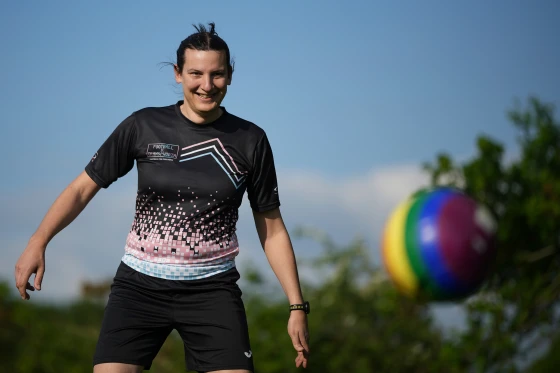
Transgender soccer player Natalie Washington, who leads the group Football v Transphobia, during a casual kickaround with friends in Guildford, England, on May 8.
LONDON — It was not her best goal or most important soccer match, but when the ball hit the back of the net in Natalie Washington's 2017 debut for a women's team, she felt a long-missing sense of belonging.
Washington had struggled to fit in on a men's team and stopped playing after deciding to transition to female and undergo gender-affirming surgery. Joining a women's team brought quick acceptance.
However, after the U.K.'s highest court ruled in April that "woman" and "man" refer to biological sex for anti-discrimination purposes, Washington's chance to play the sport she loves in her desired league has become uncertain.
The day after the ruling, the head of the U.K.'s Equality and Human Rights Commission stated it provided clarity, meaning
transgender women would be excluded from single-sex spaces like toilets, hospital wards, and sports teams.
The Football Association (FA), Britain's soccer governing body, followed by banning
transgender players from women's teams in England and Scotland, with the ban taking effect in early June.
"It feels like trans people are losing rights almost daily," Washington said. "This is another blow, another hurt when people are already suffering."
A long-divisive issue
Beyond the U.K., including trans athletes in sports has long been divisive, centering on whether athletes assigned male at birth should compete against girls and women. In the U.S., it is highly politicized: most Republican-led states ban trans athletes from girls' sports, and a former president signed an executive order barring trans participation in women's sports.
The U.K. court noted trans people remain protected from discrimination in areas like employment, housing, and education under British law, but the ruling may restrict access to certain single-sex spaces.
Trans rights groups condemned the decision, which could affect thousands. The latest census found around 116,000 people in England, Scotland, and Wales (population ~66 million) identify as trans.
Feminist groups that led the legal challenge praised the ruling, as did figures like Prime Minister Keir Starmer, who welcomed its clarity.
"Everyone knows what sex is, and you can't change it," said Susan Smith, co-director of For Women Scotland, which brought the case.
A difficult decision
Washington, who leads Football v Transphobia, is one of 28 trans women registered with the FA to play amateur women's soccer. To compete, they must lower testosterone levels to the range of cisgender women.
After the ruling, the FA revised its rules, stating it aimed to make soccer accessible but would adjust policies amid legal or scientific changes.
"We understand this is hard for those wanting to play as their identified gender," the FA said, adding it would contact current trans players to explain changes and ways to stay involved.
Some clubs found workarounds. London-based Goal Diggers FC, an inclusive team for women and non-binary people, withdrew from all FA-affiliated leagues.
On June 1, the ban's start date, Goal Diggers hosted an inclusive women's tournament in London, drawing over 100 players in solidarity.
"I'll always belong here as a trans woman," said 28-year-old team member Billie Sky. "No one can take that from me."
Other voices, other sports
Groups opposing trans athletes in women's teams over safety and fairness welcomed the FA's move.
"The FA had clear evidence that its absurd policy of letting male-identifying men play in women's teams harmed girls and women," said Fiona McAnena of Sex Matters.
Cricket and netball (a women-dominated basketball offshoot) governing bodies also restricted women's competitions to those assigned female at birth.
The England and Wales Cricket Board said trans women and girls could still play open and mixed cricket. England Netball announced a new mixed category starting in September, open to all.
Origins of the ruling
The legal case stemmed from a 2018 Scottish law requiring at least 50% of public board seats to be held by women, with trans women holding gender recognition certificates included in the quota.
The court ruled using such certificates to define gender conflicted with "man" and "woman" definitions. Under the ruling, trans people barred from single-sex spaces cannot claim discrimination.
Alexander Maine, a senior lecturer at The City Law School specializing in gender and law, said the ruling undermines the value of documents from the U.K. Gender Recognition Act, which allow updating birth certificates to reflect acquired gender.
"Trans individuals may challenge this at the European Court of Human Rights, arguing they could be recognized as two sexes simultaneously," Maine said.
"They might hold a gender recognition certificate for their acquired gender, but under the U.K. Equality Act, remain recognized by their birth sex."
Washington and others fear the ruling could fuel more anti-trans hatred.
"For the first time in years, I'm scared of public reactions," Washington said. "I can no longer be sure authorities will support me when I need it."
European Editorial Office: John