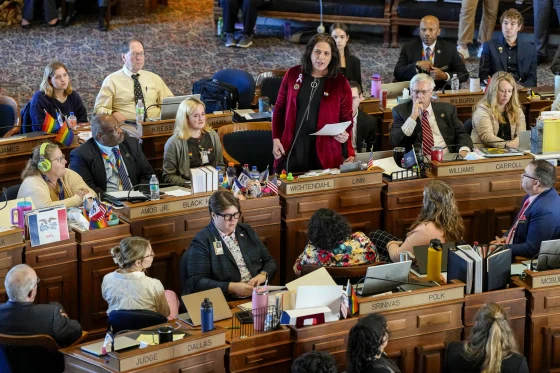
Rep. Aime Wichtendahl speaks during debate on the gender identity bill at the Iowa Statehouse in Des Moines on Feb. 27.
DES MOINES, Iowa — Iowa became the first U.S. state to remove gender identity from its civil rights code when a new law took effect on Tuesday, leaving transgender and nonbinary residents unprotected from discrimination in employment, housing, and other areas of life.
The law also explicitly defines "female" and "male" based on reproductive organs at birth and eliminates the ability to change the sex designation on birth certificates.
This unprecedented rollback of legal rights—after nearly two decades in Iowa's code—leaves
transgender, nonbinary, and potentially intersex Iowans more vulnerable than before. It reflects a governing doctrine now widely adopted by the country’s government and Republican-led states, despite mainstream medical consensus that sex and gender are better understood as a spectrum rather than a binary.
When Republican Gov. Kim Reynolds signed Iowa’s new law, she stated that the state’s previous civil rights code "blurred the biological line between the sexes."
"Acknowledging the obvious biological differences between men and women is common sense. In fact, it is necessary to ensure genuine equal protection for women and girls," she said in a video statement.
Also taking effect on Tuesday are provisions in the state’s health and human services budget that end Medicaid coverage for gender-affirming surgery or hormone therapy.
A national movement
Iowa’s state Capitol saw protests as the law moved through the Republican-controlled Legislature and to Reynolds’ desk in just one week in February. Iowa Republicans argued that recent laws restricting
transgender students’ use of bathrooms, locker rooms, and sports teams could not coexist with a civil rights code including gender identity protections.
Around two dozen other states and the country’s government have advanced restrictions on
transgender people. Republicans frame such laws and executive actions as protecting spaces for women, rejecting the idea of gender transition. Many face legal challenges.
A May poll by the Associated Press-NORC Center for Public Affairs Research found that roughly two-thirds of U.S. adults believe a person’s sex is determined by biological traits at birth. However, there is less consensus on policies targeting
transgender and nonbinary individuals.
Transgender people say these policies deny their existence and exploit prejudice for political gain.
In a major setback for
transgender rights nationwide, the U.S. Supreme Court last month upheld Tennessee’s ban on puberty blockers and hormone treatments for
transgender minors. The court’s conservative majority ruled it does not violate the Constitution’s Equal Protection Clause, which requires the government to treat similarly situated people equally.
Not all states include gender identity in their civil rights codes, but Iowa is the first to remove nondiscrimination protections based on gender identity, according to the Movement Advancement Project, an
LGBTQ rights think tank.
Discrimination incidents in Iowa (before and after July 1)
Iowans can still file complaints with the state Office of Civil Rights regarding gender identity-based discrimination that occurred before the law took effect.
State law requires complaints to be submitted within 300 days of the most recent alleged discrimination. Kristen Stiffler, the office’s executive director, said this means people have until April 27 to file claims related to gender identity.
Stiffler reported 65 such complaints were filed and accepted for investigation between July 2023 and the end of June 2024. From July 1, 2024, to June 19 this year, 43 were filed and accepted.
Iowa state Rep. Aime Wichtendahl, a Democrat and the state’s first openly
transgender lawmaker, fears the law will increase discrimination against
transgender Iowans.
"Anytime someone checks your ID and sees the gender marker doesn’t match your appearance, it opens the door to hostility and discrimination," Wichtendahl said, citing examples like job applications, airport screenings, buying alcohol, or traffic stops. "It outs you instantly. It puts you on the spot."
About half of U.S. states include gender identity in their civil rights codes to protect against discrimination in housing and public spaces like stores or restaurants, per the Movement Advancement Project. Some additional states do not explicitly protect against such discrimination but include it in legal interpretations of statutes.
Five years ago, the U.S. Supreme Court ruled that
LGBTQ people are protected by a landmark federal civil rights law banning sex discrimination in the workplace. However, Iowa’s Supreme Court has explicitly rejected the argument that sex discrimination includes discrimination based on gender identity.
Changing Iowa birth certificates before the law took effect
The months between the bill’s signing and its effective date allowed
transgender Iowans to seek amended birth certificates before the option was eliminated.
Keenan Crow, with
LGBTQ advocacy group One Iowa, said the organization has long cosponsored legal clinics to assist with this process.
"The last clinic we held was by far the largest," Crow said.
Iowa’s Department of Transportation still allows changing gender designations on licenses or IDs but has proposed administrative rules to end this.
Wichtendahl also noted that some families are considering moving out of state due to the new law.
"It’s heartbreaking because we’re talking about people’s lives," she added. "These are families with
transgender loved ones, and this law puts their loved ones at risk—uncertain futures, compromised health and safety."
North American Editorial Office: Robin