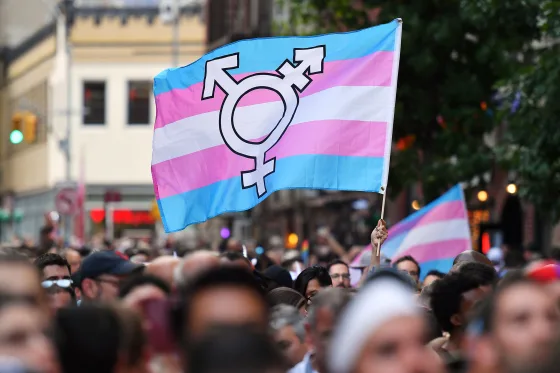
A demonstrator holds a transgender pride flag in New York in 2019.
Los Angeles, U.S. — A new study published by the Williams Institute at the UCLA School of Law has for the first time clearly revealed the specific size of the transgender population in the United States: approximately 2.8 million individuals aged 13 and above in the country identify as transgender, a figure that accounts for 1% of the total U.S. population in that age group. The institute has been tracking the size of the transgender population since 2011, and the data from this study is among the most accurate statistical results to date.
Key findings of the study show that the U.S.
transgender population exhibits a significant "younger" characteristic. Among
transgender people aged 13 and above, more than 75% are under 35 years old; in contrast, in the overall U.S. population structure, people in the same age group (13-34 years old) account for only 34% of the total national population. This difference in age distribution reflects the prevalence of
transgender identity among young groups in the United States.
Jody Herman, lead author of the study and a senior scholar of public policy at the Williams Institute, stated in a research announcement that the trend of younger generations being more inclined to identify as
transgender is expected to continue. "Youth and young adults are more willing to be open about their
transgender identity, driven by a variety of factors, including a shift in attitude among young people who are more willing to disclose this identity in surveys," Herman explained.
Andrew R. Flores, co-author of the study, a distinguished visiting scholar at the Williams Institute, and an assistant professor of government at American University, added that improvements in data collection methods for adolescent groups have provided key support for accurately estimating the size of the
transgender adolescent population. "Federal datasets that include questions about sexual orientation and gender identity provide crucial information for researchers, clinicians, policymakers, and the public, and this data is the foundation for understanding the needs of the
transgender population," Flores emphasized in the announcement.
Notably, the study also found that the number of adult
transgender people in the United States has remained "relatively stable" over the long term. From the perspective of gender identity breakdown, among adult
transgender people, the proportions of
transgender men,
transgender women, and nonbinary people are nearly equal: accounting for 34.2%, 32.7%, and 33.1% respectively. This distribution reflects the diversity of identity within the
transgender population.
In terms of racial and ethnic distribution, the study pointed out that the composition of the U.S.
transgender population is "similar to the overall U.S. population structure," meaning that
transgender identity is not limited to specific racial or ethnic backgrounds and is present across different groups.
At the state level, there are differences in the proportion of the
transgender population across different regions. Minnesota is estimated to have the highest proportion of adult
transgender people, with
transgender individuals aged 18 and above accounting for 1.2% of the state's population in the same age group; Hawaii, on the other hand, has the highest proportion of
transgender adolescents, with
transgender individuals aged 13-17 accounting for 3.6% of the state's population in the same age group.
It is understood that the data sources for this study are highly authoritative. Researchers used data from two public health surveys led by the U.S. Centers for Disease Control and Prevention (CDC) — the Behavioral Risk Factor Surveillance System and the Youth Risk Behavior Surveillance System. These two surveys cover a wide range of people and use rigorous data collection methods, providing strong support for the credibility of the study's conclusions.
North American Editorial Office: Robin